

Alcoa Rides an Aluminium Supply Squeeze Into a Middle East Shock
Fund managers say structural supply deficits and Gulf smelter disruption have driven a sustained rally, even as shipping costs bite
30 Jun 2026 · 4 min read
In short
Alcoa Corporation rose 59.8% in the December 2025 quarter on structural aluminium supply deficits in the US, Europe and China.
Iranian military strikes on Gulf aluminium smelters in March 2026 drove global aluminium prices up 18.2% over the quarter.
Alcoa's Q1 2026 EBITDA missed expectations by around 8% as Middle East shipping disruption cut alumina and aluminium shipments 4-5%.
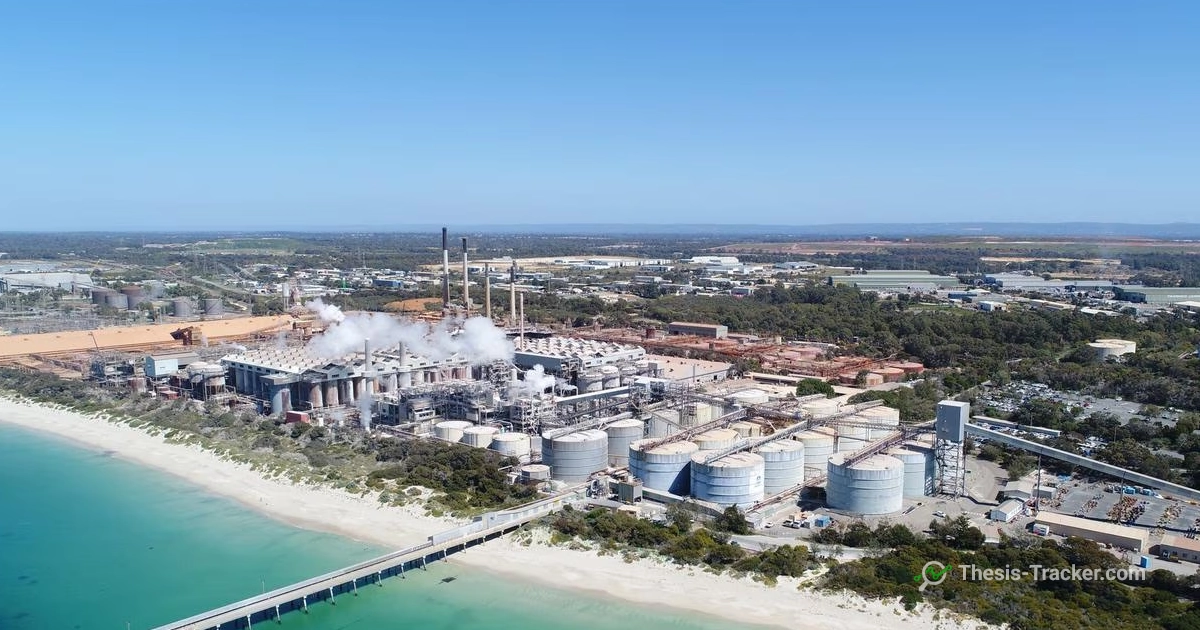
Global aluminium producer Alcoa Corporation delivered exceptional returns through late 2025 and early 2026 as tight global supply met a series of supply shocks, culminating in Middle East smelter strikes that pushed aluminium prices sharply higher.
A structural supply squeeze builds through 2025
Wilson Asset Management's November 2025 update described the tightening backdrop: China reaching its aluminium production capacity ceiling, structural deficits emerging in the US and Europe, and accelerating global demand, all while Alcoa pursued productivity improvements and cost reductions. Solaris Investment Management's December quarterly update reported the stock up 59.8 per cent that quarter alone, citing Alcoa's globally competitive, vertically integrated cost position, a fortress balance sheet, and positioning for secular electrification demand as aluminium increasingly substitutes for constrained copper supply in EVs and renewables.
Globally competitive cost position: Vertically integrated from mine to metal with predominantly renewable energy across smelting operations, providing structural cost advantages and favourable positioning on the global cost curve. Positioned for secular electrification demand: Aluminium increasingly favoured in electric vehicles and renewable energy applications as copper supply constraints intensify.
— Solaris Investment Management, Quarterly Report, December 2025
Some managers take profits into strength
Not every fund held on. Wentworth Williamson exited its position in the December quarter, crystallising a solid gain after its investment thesis played out rapidly, consistent with its disciplined sell framework. L1 Capital reported exiting in January 2026 after a 50 per cent gain since its recent investment, while Ellerston Capital exited around the same time as the company approached what it saw as peak price to book multiples, even as Oracle Advisory Group still saw Alcoa trading cheaply at 13 times earnings given ongoing China production limits and the potential removal of US tariffs.
A Middle East conflict disrupts Gulf smelters
The next major catalyst arrived in March 2026. Paradice Investment Management reported Iranian military strikes on Gulf-based aluminium smelters disrupted a significant portion of global supply, driving aluminium prices up 18.2 per cent over the quarter. Ellerston Capital detailed the mechanism further: curtailments of aluminium production across numerous Gulf states from military strikes on production facilities, compounded by disruption to shipping through the Strait of Hormuz, sending Alcoa shares up 17 per cent for the quarter despite having no assets in the affected region.
By contrast, the aluminium price rallied strongly, +13.5%, following significant damage to several smelters in the Persian Gulf. This saw outperformance by our holding in Alcoa (+5.7%), which has no assets in this region. This comes on top of an already tight aluminium market, which has seen capacity reductions in recent times.
— Perennial Partners, Monthly Report, March 2026
Shipping disruption offsets some of the price gains
Pendal Group's April 2026 update showed the disruption cutting both ways: Alcoa's first-quarter results missed EBITDA expectations by around 8 per cent as alumina and aluminium shipments fell 4 to 5 per cent due to Middle East shipping disruption, even as the company redirected around a third of its typical Middle East alumina shipments to China and secured supplier commitments on its Western Australian diesel position through to the end of May. Paradice Investment Management's June 2026 update showed the position unwinding somewhat as the conflict subsided, with third-quarter shipments and free cash flow missing due to lower third-party alumina sales, seasonality and proactive inventory repositioning within North America.
Questions
What drove Alcoa Corporation's strong performance in late 2025?
Wilson Asset Management and Solaris Investment Management said Alcoa benefited from structural aluminium supply deficits as China hit its production capacity ceiling and the US and Europe faced tightening supply, alongside operational cost improvements at the company.
How did the Iran conflict affect Alcoa Corporation's share price?
Paradice Investment Management and Ellerston Capital reported that Iranian military strikes on Gulf-based aluminium smelters in March 2026 drove global aluminium prices up 18.2% over the quarter, lifting Alcoa shares 17% despite the company having no assets in the affected region.
Did the Middle East conflict hurt Alcoa Corporation's results?
Pendal Group said Alcoa's Q1 2026 EBITDA missed expectations by around 8% as Middle East shipping disruption cut alumina and aluminium shipment volumes by 4-5%, even as the company benefited from higher prices overall.
10 managers, 16 comments, with each manager's latest recorded position.
See AAI