

Why income fund managers keep buying Dalrymple Bay Infrastructure
A take-or-pay lease over the world's largest metallurgical coal export terminal is delivering inflation-linked, predictable distributions that keep attracting yield-focused managers.
30 Jun 2026 · 6 min read
In short
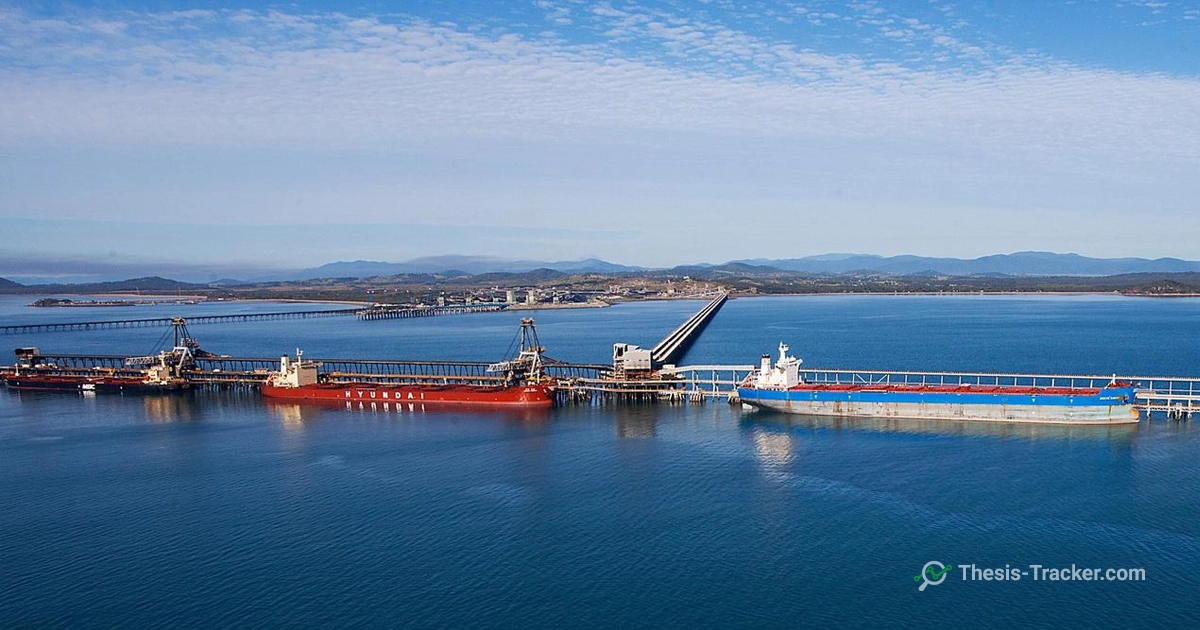
Dalrymple Bay Infrastructure holds a lease over the Dalrymple Bay coal terminal until 2051, with an option to extend to 2100, under take-or-pay contracts.
A December 2025 debt refinancing saved the company $75 million over five years and drove a 14% share price rally that month.
Investors Mutual Limited notes management has guided to 3-7% annual growth in distributions, with a further repricing opportunity when contracts renew in 2031.
Coal export terminal owner Dalrymple Bay Infrastructure continues to be championed by income-focused managers for the predictability of its cash flows. Investors Mutual Limited's June 2026 Article, a guest buy pick, described the business as holding a lease over the Dalrymple Bay coal terminal until 2051, with an option to extend to 2100, generating inflation-linked pricing under contracts that carry no volume or operating cost risk.
Take-or-pay contracts insulate cash flow from coal volumes
The structural appeal is consistent across almost every manager who has covered the stock. Blackwattle Investment Partners' September 2025 Article described a fully contracted profile in which miners pay for capacity whether they use it or not, with operating costs passed through to customers and socialised across the terminal's user base. Contact Asset Management's March 2026 Quarterly Report classified DBI as a Heavy Assets, Low Obsolescence business, noting its relevance has increased rather than diminished during periods of market dislocation.
They get increases in their distributional cash flows above and beyond inflation because they're investing non-expansion CapEx. So they've guided to 3% to 7% growth in distribution per annum for the foreseeable future.
— Investors Mutual Limited, Article, June 2026
A December 2025 debt refinancing was a clear catalyst across multiple managers' commentary. Blackwattle Investment Partners' December 2025 Monthly Report detailed a rally of 14% in the month as the company refinanced its USPP notes at a materially improved interest rate, saving $75 million over five years, while LHC Capital's Quarterly Report noted shares had risen 45.7% over the year before the fund exited its position, viewing DBI as better suited to active trading than as a long-term core holding given it is a single-asset operator running at full capacity.
What managers are watching next
Market Partners and Ten Cap both nominated DBI a buy in June 2026 articles, with Ten Cap noting distributions are expected to grow around 8.5% for the year, unusually strong growth for what is typically a low-growth yield stock. Investors Mutual Limited points to 2031 as the next major catalyst, when current regulated contracts expire and DBI has the opportunity to reprice access relative to nearby competitor ports, with demand for terminal capacity currently exceeding supply by 37%.
Questions
What makes Dalrymple Bay Infrastructure's contracts defensive?
According to Investors Mutual Limited, Dalrymple Bay Infrastructure operates under take-or-pay contracts, meaning coal producer customers pay for terminal capacity regardless of whether they use it, while operating and maintenance costs are passed through and socialised among all customers.
Why did Dalrymple Bay Infrastructure's share price rise in December 2025?
Blackwattle Investment Partners notes the stock rallied 14% in December 2025 after the company refinanced its USPP notes at a materially improved interest rate, saving an estimated $75 million over five years.
What is the next major catalyst for Dalrymple Bay Infrastructure?
Investors Mutual Limited points to 2031, when Dalrymple Bay Infrastructure's current regulated contracts expire, giving the company an opportunity to reprice terminal access relative to higher-priced competitor ports given demand currently exceeds capacity by 37%.
17 managers, 31 comments, with each manager's latest recorded position.
See DBI