

Sims Limited's Accidental AI Trade Meets a Guidance Speed Bump
Server recycling and a strong scrap steel cycle drove a near-doubling in the share price, before hyperscaler delays clouded the outlook for FY27.
4 Sep 2026 · 3 min read
In short
Sims Limited nearly doubled as its Sims Lifecycle Services division became an unlikely AI data centre play, recycling decommissioned servers and benefiting from surging memory chip prices.
Traditional scrap metal operations also beat expectations, with a 15% surprise FY26 EBIT upgrade in June driven by strong US steel prices and aluminium scrap pricing.
Shares fell in August after FY27 guidance for the data-centre chip-recycling business disappointed on hyperscalers delaying equipment refurbishment, though NorthStar Impact Funds views it as a timing issue rather than a trend change.
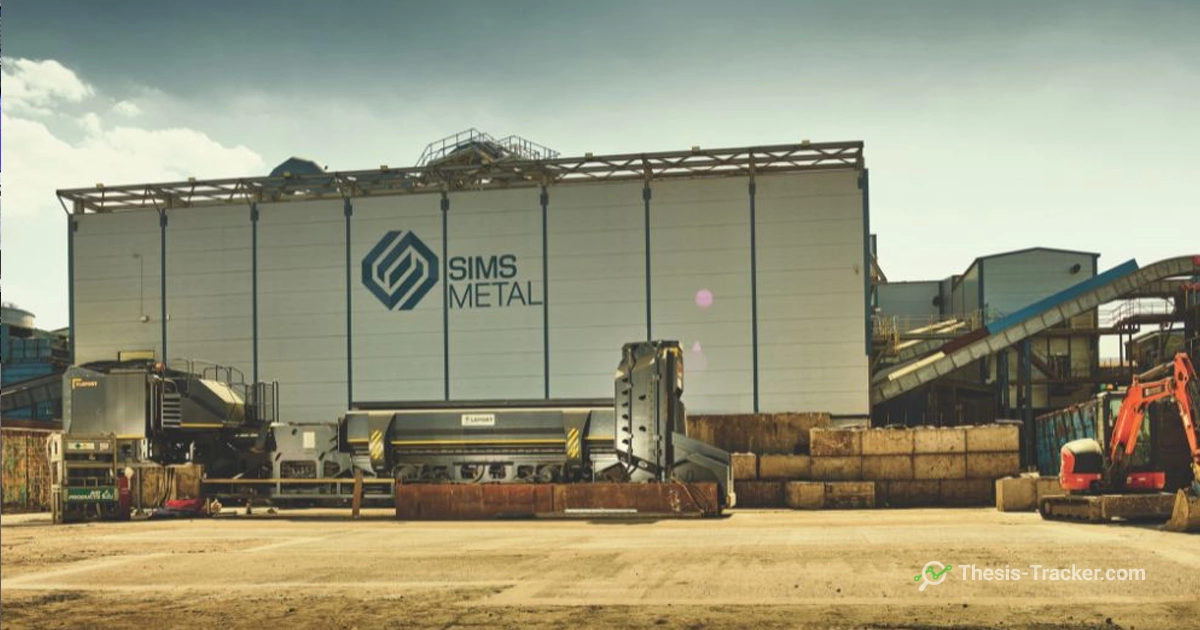
Sims Limited nearly doubled through 2025 and 2026 as it became an unlikely way to play the AI data centre boom through its server recycling division, before an August guidance disappointment in that very business sent the stock down, even as its traditional scrap metals operations kept beating expectations.
An idiosyncratic AI capex play hiding in a scrap metals company
Maple-Brown Abbott described Sims as a core holding it uses as an idiosyncratic way to play the AI capital expenditure boom, since hyperscalers refreshing data centre hardware at an accelerated pace, combined with surging memory prices, have lifted the resale value of decommissioned servers and components flowing through Sims Lifecycle Services. Milford Asset Management said the stock rallied on improving sentiment toward that Lifecycle division, with data centre and AI infrastructure growth accelerating IT hardware turnover and creating opportunity in asset recovery and redeployment it expects to persist over the medium term. Longwave Capital noted around 80 percent of Sims's economic operating revenue is generated outside Australia and New Zealand, with Sims Lifecycle Services growing 70 percent, while NorthStar Impact Funds said the division's exposure to DRAM memory chips gives it rare exposure to Taiwan's technology supply chain on the ASX.
Sims has been a core holding since last year, being an idiosyncratic way to play the AI capex boom.
— Maple-Brown Abbott, Article, May 2026
The traditional scrap business quietly does the heavy lifting too
Yarra Capital Management held an overweight position, attracted to improving fundamentals in scrap metals given US tariffs on steel and copper imports, a positive for Sims's US domestic recycling operations, with prices also supported by supply and freight disruption tied to the Iran conflict. Perennial Partners said the stock rose 29.7 percent in May on strong pricing for recycled aluminium, copper and other metals alongside the data centre server cycling exposure. Spheria Asset Management trimmed its holding for relative valuation reasons but still believes the market undervalues Sims's property-backed metals recycling operations, which it expects to keep improving as electric arc furnace capacity expands in the US, lifting domestic demand for scrap steel.
The stock has broadly doubled over the last 12 months, but we think there are further catalysts to come. The stock is now trading at about $29, we think there's a pathway to north of $35.
— Yarra Capital Management, Article, June 2026
A surprise upgrade, then a guidance disappointment
Pendal Group said Sims delivered a surprise 15 percent upgrade to FY26 EBIT in June, driven by strength in the traditional scrap business as aluminium scrap prices rallied and ferrous scrap margins expanded on a strong US steel price environment, even though FY26's earnings growth had largely been driven by the server recycling division riding high chip prices. That changed in August, when Sims beat second-half EBIT expectations by 13 percent on unexpectedly strong North American ferrous scrap performance, but the stock still fell after FY27 guidance for the data-centre chip-recycling business disappointed, with hyperscalers delaying equipment refurbishment amid a short-term correction.
Bulls see the sell-off as a timing issue, not a trend change
NorthStar Impact Funds said it topped up its position into the post-result sell-off, arguing steel remains a strong US end market and that the Sims Lifecycle Services guidance miss reflects a first-half timing issue tied to the variability of data centre decommissioning schedules, rather than a change in the underlying trend, and reiterated that memory exposure remains difficult to find elsewhere on the ASX.
What fund managers say they are watching next is whether the hyperscaler equipment refurbishment delay proves temporary, continued strength in US scrap steel and ferrous pricing, delivery of the pathway toward $35 that Yarra outlined, and how DRAM and memory pricing trends flow through Sims's rare Taiwan-tech-adjacent exposure.
Questions
How is Sims Limited connected to the AI data centre boom?
Sims Limited's Lifecycle Services division recycles decommissioned data centre servers and components, benefiting from hyperscalers refreshing hardware at an accelerated pace and surging memory chip prices lifting resale values.
Why did Sims Limited's traditional business perform strongly in 2026?
Sims Limited's scrap metals business delivered a surprise 15% FY26 EBIT upgrade driven by strong US steel prices and rallying aluminium scrap prices, partly supported by US tariffs on steel and copper imports.
Why did Sims Limited's share price fall in August 2026?
Sims Limited fell after FY27 guidance for its data-centre chip-recycling business disappointed, as hyperscalers delayed equipment refurbishment, even though the company beat second-half EBIT expectations by 13% overall.
10 managers, 26 comments, with each manager's latest recorded position.
See SGM