

Why fund manager commentary is so hard to find
Australian fund managers publish what they think about ASX companies every month, and all of it is publicly available, yet it is hard to find by search and never organised by company. Here is why, and how Thesis Tracker fixes it.
Updated 17 Nov 2026 · 7 min read
In short
Australian fund managers publish detailed views on ASX companies every month, and anyone can read them on the managers' websites. They are hard to find because search engines revisit small fund sites infrequently and rank them below larger sites, reports rarely name the company's ASX code, more of it is spoken in webinars and podcasts, and nothing is organised by company. Thesis Tracker reads those publications and records each manager's comment and reported position change against the company, so you can see on one page what every manager has said.
Every month, dozens of Australian fund managers explain to their investors what they bought, what they sold and why. They name ASX companies, describe the thesis, admit the mistakes and say when they have changed their mind. For an investor researching a company, it is some of the most useful writing there is: professionals with full-time research teams, putting their reasoning on the record.
It is all publicly available. Anyone can open a fund's website and read its latest report. Yet search for what fund managers think of a mid-cap ASX company and you will get news, broker notes, forum threads and the company's own announcements, and rarely the managers' own words. The commentary is open to read; it just isn't easy to find. Here is why.
1. Search engines visit fund websites infrequently
Search engines decide how often to revisit a site by how often it changes and how important it seems. Most fund websites change once a month, when the new report goes up, so they are crawled rarely. A new monthly report can take weeks to appear in search results, and by then the next one is often out. For commentary on a company, a few weeks can be the difference between context and history.
2. Fund websites aren't built to be found
Many fund managers' websites were built years ago for existing investors, not for search. Reports are often published as PDFs with generic titles ("Monthly Report, October") and no description of what is inside, so a search engine has little to tell it that page seven discusses a particular company. Good writing ends up with poor discoverability.
3. Small sites rank below big ones
Search engines rank pages partly on the reputation of the site they sit on, measured largely by how many other sites link to it. A boutique fund manager's website has few links compared with a news site, a broker or a busy forum, so even when a manager has written the most informed paragraph on a company, larger sites with thinner content outrank it.
4. The company isn't always clear
Managers write for their investors, not for search engines. They refer to a company by its name, a short name or a nickname, rarely by its ASX code, and companies change names, merge and share similar names. A search for a ticker won't find a report that never mentions it. Thesis Tracker matches every comment to the company's ASX code, so it sits on the right company page however the manager referred to it.
5. More of it is spoken, in video and audio
A growing share of what managers say is spoken: webinars, investor days, YouTube interviews, podcasts and conference panels. A manager might explain a new position in minute 34 of a 60-minute webinar. That is public, but it is hard to find unless you sit through the recording, and it is not searchable by company.
6. Nothing is organised by company
Commentary is organised by manager and by date: each fund publishes its own reports, in its own format, on its own site. To know what managers think about one company you would need to read every report from every fund, every month, and pull out the paragraphs that matter. With more than 160 managers publishing, nobody has the time. And there is no common language: one manager "initiated a position", another "added to our holding", a third "took some profits".
How Thesis Tracker fixes it
Thesis Tracker is a database of what Australian fund managers publish about ASX-listed companies. We read managers' monthly and quarterly reports, newsletters, articles and other publications as they come out, and record every comment on an ASX company as its own entry:
- who said it (the manager) and when (the publication date),
- which company it is about, matched to its ASX code and filed under that company's page,
- what they reported doing, in plain, consistent labels: new position, increased, held, reduced, exit or short,
- the share price on the day, and a short summary of what they said.
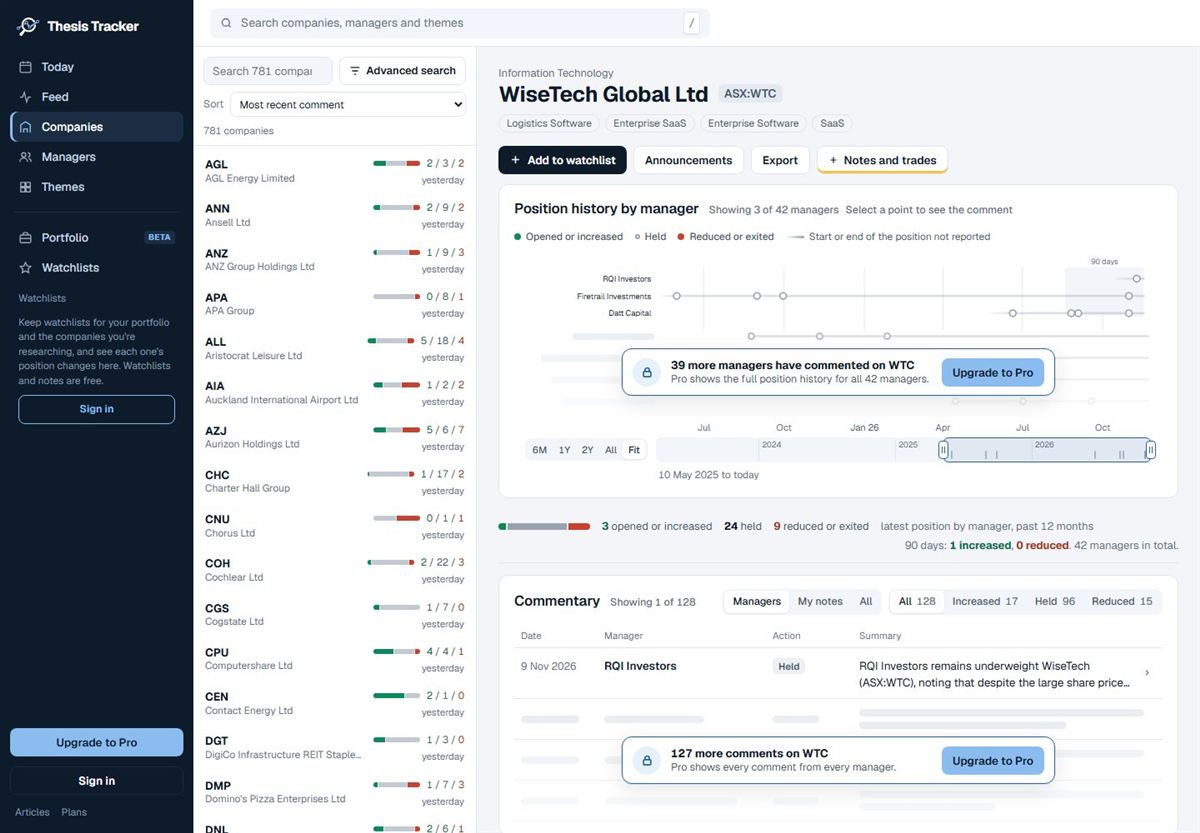
Because every comment is filed by company, you can open any ASX company and see, on one page, every manager who has written about it, what each one last reported doing, and how those views have changed over time.
Why compliance matters here
Fund managers' reports are written for their investors, by licensed firms whose published material generally goes through compliance review. They are named, dated and on the record: a manager reporting on their own fund has every reason to describe it accurately.
Thesis Tracker is built to keep that record straight:
- We record only commentary that managers have published publicly.
- Every comment is attributed to the named manager and the date it was published.
- We report what managers said they did, in factual labels. We don't rate companies, score managers, or add views of our own.
- Everything on the site is general information, not financial advice, and every page says so.
What you can do with it
- Check a company before you decide. See which managers own it, who has recently added or sold, and read their reasoning. See How to read a company page.
- Find ideas to research. Filter all companies by recent manager activity, first coverage, sector or theme. See Find the companies fund managers are acting on.
- Follow your own list. Keep watchlists of the companies you own or are researching, with notes and your own trades alongside. See Thesis Tracker: a research home for self-directed investors.
- Follow a manager. Every manager has a page with the companies they have discussed and their funds. Browse them on Managers.
And we don't use AI to answer your questions on the site: Pro members can export the data to use in their own tools. For how this commentary compares with other sources, see Fund manager commentary vs stock forums and Fund manager commentary vs broker research.
Questions
Is fund manager commentary public?
Yes. Fund managers publish it openly on their websites and channels: monthly and quarterly reports, investor letters, newsletters, articles, podcasts and webinars. Being public is not the same as being easy to find: search engines revisit fund websites infrequently, and none of it is organised by company.
Why can't I just search Google for what fund managers think of a company?
Search engines crawl small fund websites infrequently and rank them below news, broker and forum sites with more links. A manager's view of a company is usually one paragraph in a monthly report that may not mention the ASX code, so it rarely surfaces for a search on the company or ticker.
What does Thesis Tracker record?
One record per manager comment on one ASX-listed company: the manager, the date, the source type, the reported position change (opened, increased, held, reduced, exited or short), the share price on the day and a short summary. Each comment is attributed to the named manager and the date it was published.