

What is an APIR number?
An APIR code is the nine-character identifier for an Australian managed fund. What it looks like, where to find it, and why it matters when you research or invest in a fund.
Updated 17 Nov 2026 · 5 min read
In short
An APIR code is a nine-character identifier, such as ABC1234AU, given to Australian managed funds and other investment products so that platforms, administrators and investors can identify each product exactly. It matters because fund names change, look alike and come in several classes, while the APIR code stays with one specific product.
If you invest in Australian managed funds, you will meet the APIR code: a short string such as ABC1234AU printed on fact sheets, application forms and platform menus. It looks like admin, and it is, but it also solves a real problem for investors: making sure the fund you research is exactly the fund you buy.
What an APIR code is
An APIR code is a unique identifier for a managed investment product in Australia. Codes are issued by APIR, the organisation that runs the register, and are used across the industry: by investment platforms and wrap accounts, superannuation funds, custodians, fund administrators, research houses and financial advisers. When a platform places an order into a fund, or a research house publishes a rating, the APIR code is how everyone agrees which product they mean.
Most codes have nine characters in three parts:
| Part | Example | What it identifies |
|---|---|---|
| 3 letters | ABC | The organisation that registered the product. Often the fund's responsible entity, which is not always the investment manager. |
| 4 digits | 1234 | The individual product, or class of units, registered by that organisation. |
| 2 letters | AU | A suffix, AU for Australian products. |
ABC1234AU is an illustrative code, not a real fund.
Why it matters
Fund names are not unique
Fund names are long, similar and change over time. "Australian Equities Fund", "Australian Share Fund" and "Australian Equity Fund" can belong to three different managers. Funds are renamed when managers merge, rebrand or change their responsible entity. The APIR code stays with the product, so it is the reliable way to search for a fund, check a platform menu or match one report to another.
One fund can have several classes
Many funds offer more than one class of units: a wholesale class and a retail class, a founder class with lower fees, a class for a particular platform, or a hedged and unhedged version. The classes hold the same investments but have different fees and minimums, so their returns differ. Each class has its own APIR code. If you compare performance or fees, check you are looking at the class you can actually invest in.
It is how you place an order
On most platforms and in most adviser systems you buy an unlisted fund by its APIR code. Applying for the wrong class can mean paying a higher fee than you expected, or being rejected because you don't meet the minimum investment.
It separates unlisted from listed
Some managers run the same strategy as an unlisted fund (with an APIR code) and as a listed investment company, listed investment trust or active ETF (with an ASX code). They can have different fees, and a listed vehicle can trade at a premium or discount to the value of its assets. The two codes tell you which one you are looking at.
APIR code, ASX code and ISIN
| Identifier | Identifies | Example format |
|---|---|---|
| APIR code | An unlisted managed fund, or a class of one | ABC1234AU |
| ASX code | A security listed on the ASX: a company, LIC, LIT or ETF | ABC |
| ISIN | Any security, internationally (12 characters) | AU000000ABC1 |
Where to find a fund's APIR code
- The product disclosure statement (PDS), usually on the first pages.
- The fund's monthly fact sheet or report.
- Your platform's investment menu or the fund's page on the manager's website.
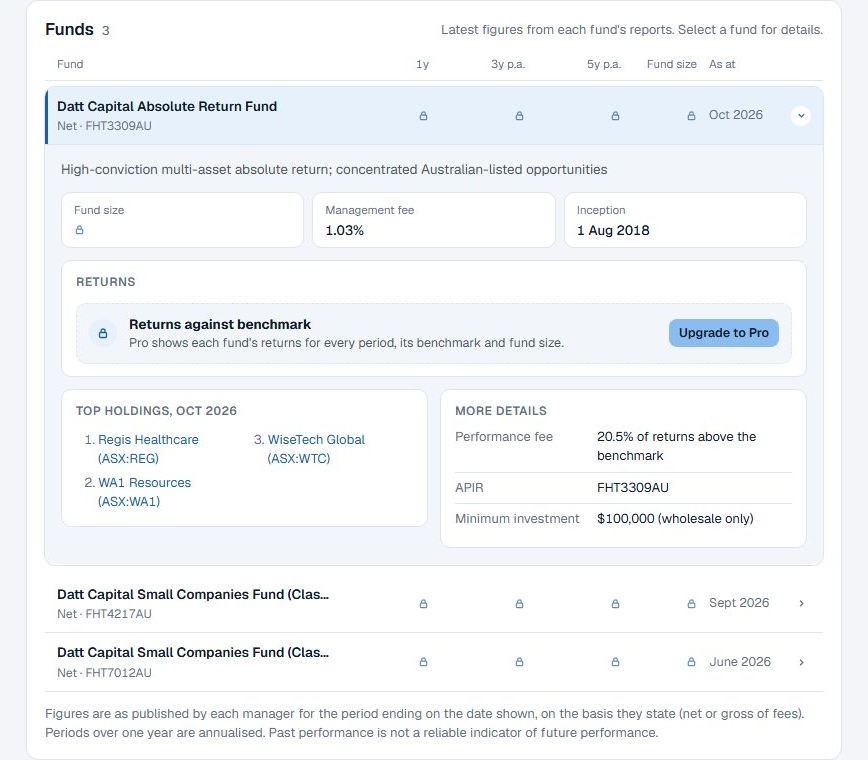
- On Thesis Tracker: each manager page lists the manager's funds, with the APIR code or ASX code, benchmark, fees and inception date where the manager publishes them.
What an APIR code doesn't tell you
An APIR code identifies a product. It is not a rating, an approval or a sign of quality: any product registered with APIR gets one. To understand a fund, read its PDS and target market determination, look at its fees, benchmark and track record, and read what the manager says in their reports. How Australian fund managers report to investors explains what those reports usually contain.
Questions
What does APIR stand for?
APIR is the name of the organisation that issues the codes and keeps the register. The codes are called APIR codes or APIR numbers.
What does an APIR code look like?
Nine characters: three letters for the issuer, four numbers for the product, and a two-letter suffix, usually AU. For example ABC1234AU (an illustrative code, not a real fund).
Is an APIR code the same as an ASX code?
No. An ASX code identifies a security listed on the ASX, such as a listed investment company or an exchange-traded fund. An APIR code identifies an unlisted managed fund or product. Some funds have both: an unlisted class with an APIR code and a listed class with an ASX code.
Where do I find a fund's APIR code?
In the fund's product disclosure statement (PDS), its monthly fact sheet, or your platform's investment menu. On Thesis Tracker, a manager page lists each fund with its APIR code where it is published.