

How to keep an investment journal
Write down why you buy and sell, what would change your mind, and how it turned out, on each company next to what fund managers wrote.
Updated 18 Nov 2026 · 4 min read
In short
An investment journal records why you made each decision, what you expected and what would prove you wrong, so you can review it later on the facts rather than the share price. On Thesis Tracker you keep it on each company page as dated Decision, Note and Review entries, with your trades and a link to your model, alongside the fund managers' comments.
Professional fund managers write down why they buy and sell. Their monthly reports are, in effect, a public journal of their decisions. Most self-directed investors keep nothing of the kind, so when a stock moves a year later they can't remember why they bought it, or what would have made them sell. An investment journal fixes that, and Thesis Tracker lets you keep one on each company, next to what the managers wrote.
Why keep a journal
- You remember the reason, not just the price. Writing the thesis down when you buy means you can check later whether it played out, rather than judging the decision by the share price alone.
- You decide in advance what would change your mind. It is much easier to set the conditions for selling before the stock has moved than after.
- You learn from your own record. Reviewing past decisions shows patterns: selling winners too early, holding on to broken ideas, or buying on a story.
Three kinds of entry
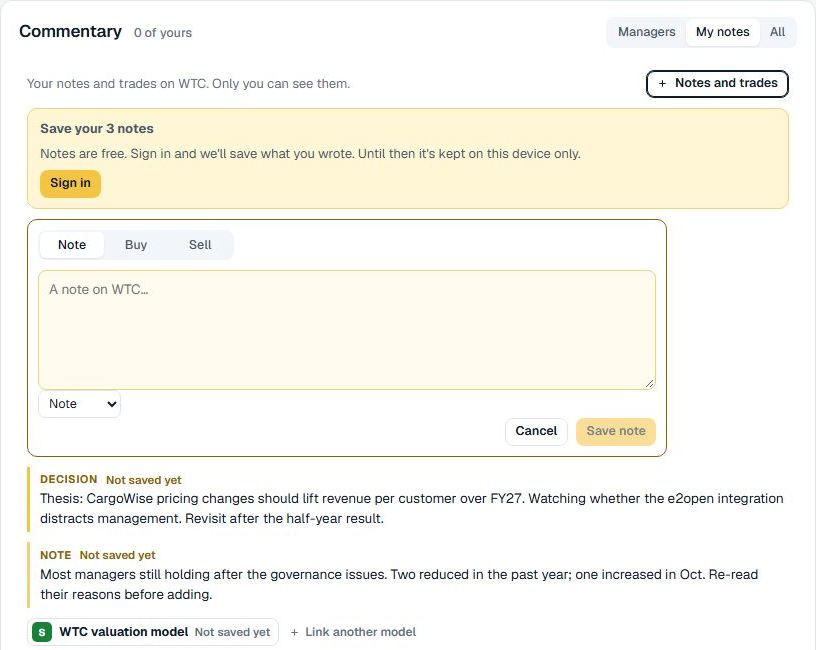
On any company page, choose Notes and trades, then Note. Each note has a type:
| Type | When to write one | What to put in it |
|---|---|---|
| Decision | When you buy, add, trim or sell, or decide not to | What you did, why, what you expect, and what would prove you wrong |
| Note | Whenever something is worth remembering | A result, a meeting, a manager's view you found persuasive, a question to check |
| Review | After a result, or every six or twelve months | What happened against what you expected, and what you would do differently |
Every note has a date, which you can set to when the decision was actually made. Notes sit on the price chart and in the commentary at that date, so you can see what you were thinking and where the price was. Only you can see them.
Record the reason with the trade
When you record a buy or sell in Notes and trades, the form asks "Why? Your thesis for this trade". What you write there is saved as a private note on the trade date. If you skip it, you are asked whether to add a note about the trade. It takes a minute and is the most useful habit in this guide.
Keep your model one click away
Choose Link your own model to attach a Google Sheet, an Excel file on OneDrive or SharePoint, or a Dropbox file to the company. Only the link is saved.
Read your journal next to the managers
Switch the commentary on a company page to All to see your notes and trades among the fund managers' comments, in date order. It is a quick way to check your thinking against professionals who have studied the same company, and to see whether any of them changed their position around the time you did.
Notes are free with an account. See Notes, trades and your portfolio for trades and the portfolio, or open a company to write your first note.
Questions
What should an investment journal entry include?
For a decision: what you did, why, what you expect to happen, and what would prove you wrong. For a review: what actually happened, and what you would do differently.
Is the journal private?
Yes. Notes and trades on Thesis Tracker are visible only to you.
Does it cost anything?
No. Notes are free with a Thesis Tracker account.