Search All
MIN
Search by Name
Search by Ticker
ASX:BHP
•
Metals and Mining
BHP's Copper Pivot Divides Fund Managers Even as Shares Sit Near Record Highs
A blowout copper result and a booming growth pipeline have some fund managers bullish and at least one shorting the stock.
TT
Thesis Tracker
24 August 2026
•
5 min read
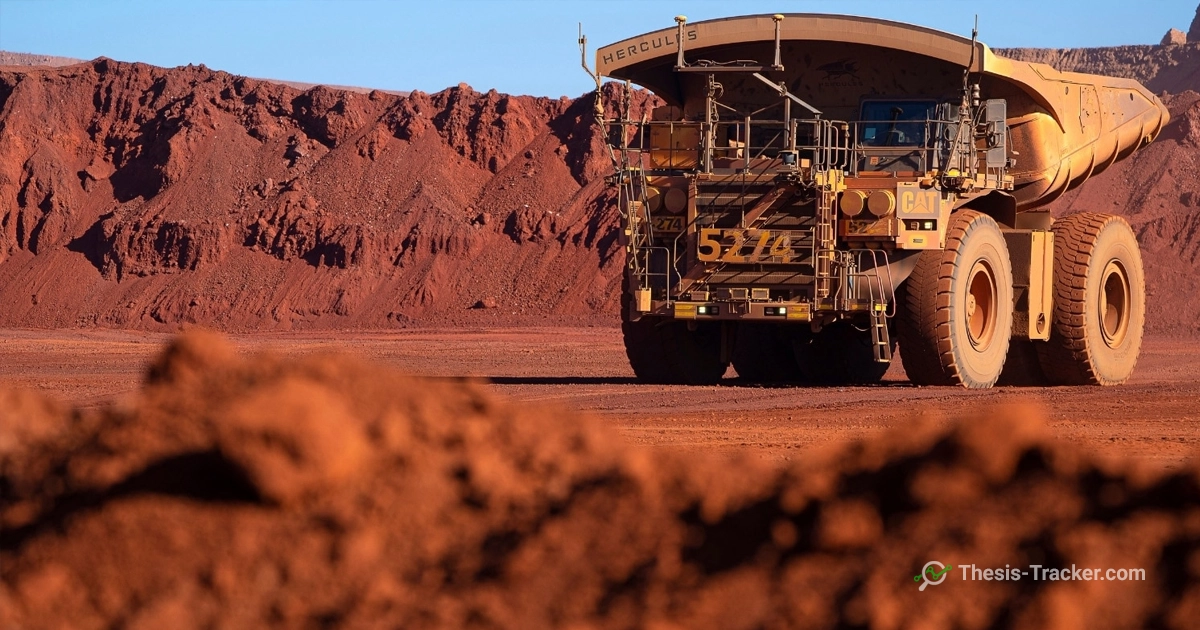
BHP's FY26 result showed copper is now 54% of earnings. Fund managers are divided, with one holding a short position on valuation grounds.
In Short
BHP's FY26 result confirmed copper has overtaken iron ore as its biggest earnings contributor, generating 54% of group underlying EBITDA.
Fund managers are split: Regal Funds Management sees BHP's copper production and market value roughly doubling this decade, while Leithner & Company holds a short position, arguing the shares are more than 40% overvalued.
A US$2.3 billion cost blowout on the Jansen potash project and a step-down in FY27 copper volumes are the near-term risks fund managers are watching under new CEO Brandon Craig.
BHP is now a copper company with an iron ore cash machine attached, and fund managers are arguing about what that is worth. The miner's FY26 result, handed down in August, confirmed that copper has overtaken iron ore as BHP's largest earnings contributor for the first time, arriving just as the shares trade near the record high they set in June. That combination has split opinion sharply. Some managers think the market still underestimates how much bigger BHP's copper business can become. At least one thinks the stock is simply overvalued and has taken a short position against it.
Copper has taken over as the earnings engine
Tamim Funds Management laid out the shift in detail: in the FY26 result, copper generated more than US$18 billion of underlying earnings, or 54 percent of the group total, up from 50 percent in the prior half. Group revenue rose 15 percent to US$58.76 billion and underlying attributable profit, stripping out one-off items, rose 30 percent to US$13.20 billion. Net debt fell to US$8.7 billion from US$12.9 billion a year earlier, and the fully franked final dividend of 99 US cents took the full-year payout to US$1.72 per share, the highest in four years and a payout ratio of 72 percent. Plato Investment Management called it simply a strong result, pointing out that BHP's copper margins, at around 70 percent, now sit even above its already strong iron ore margins, and that the business continues to take costs out.
Pendal Group's August newsletter framed the result as a beat, with underlying earnings 4 percent ahead of estimates on better than expected costs at the Escondida copper mine, free cash flow of US$10 billion, and a payout ratio lifted to 66 percent, above the roughly 55 percent average of recent years. Pendal noted the contrast with a year earlier, when BHP was cutting capital spending and flagging asset sales, and said it does not expect the recent re-rating in the shares to reverse in the near term.
The growth pipeline comes with a cautionary tale
The same result carried a warning. Tamim pointed to a US$2.3 billion impairment on the Jansen potash project in Saskatchewan, where the second stage's cost estimate rose 41 percent to roughly US$6.9 billion and first production slipped to late FY2031. BHP is committing close to US$11 billion a year in capital and exploration spending over FY27, split across copper growth projects including an Escondida concentrator, the Ministers North iron ore expansion in the Pilbara, and the Vicuña copper district in Argentina. Tamim's view is that the pattern at Jansen, large mining projects tending to cost more and take longer than approved, is a reason to treat BHP's growth pipeline with some caution even as the underlying assets remain high quality. Copper volumes are also guided to step down in FY27 before the growth projects arrive, as grades decline at Escondida, and a new chief executive, Brandon Craig, has just taken the reins, a transition Tamim flagged as one that often brings portfolio reviews and can produce further impairments or changed capital priorities.
Bulls see a much bigger BHP still to come
Regal Funds Management's Julian Aitken went further, arguing consensus badly underestimates BHP's future earnings. He pointed to BHP's own guidance for copper production to rise 50 percent by the mid-2030s, with three major projects due online over the next 12 to 18 months, self-funded and still leaving a projected US$35 billion of attributable free cash flow over five years. Aitken argued that investment banks forecasting BHP's earnings to go backward over the next three years are betting on commodity prices reverting to the cost curve, something copper has rarely done. On his numbers, BHP's index weight could eventually roughly double from here.
My gut feel is in a few years' time that BHP's ASX200 index weight will be around 15% and CBA's circa 8.5%... I can see a scenario where BHP is double the market cap of CBA.— Regal Funds Management, Article, August 2026
Not everyone is convinced
Leithner & Company took the opposite view in July, when BHP shares briefly touched an all-time high above $65. The fund estimated the stock was more than 40 percent overvalued at that price, with fair value closer to $37.50, or nearer $30 for conservative investors, and said it had taken a short position. Leithner does not dispute that BHP is a well-run, world-class business. Its argument is about price: that bulls have overhyped the copper outlook and, in doing so, priced in returns the company is unlikely to deliver over the next five to ten years.
BHP is a great company, but at $65 its shares make a poor investment.— Leithner & Company, Article, July 2026
That view sat alongside more cautious portfolio moves elsewhere. Alliance Bernstein trimmed its BHP position in July after the stock's outperformance, taking profits rather than adding. Blackwattle Investment Partners noted BHP underperformed for a stretch as the iron ore price came under pressure from a prolonged China property downturn, buying-power pressure from China's state-backed resources group, and rising global supply as Guinea's Simandou project ramps up, a reminder that the iron ore side of the business still carries real cyclical risk even as copper takes the spotlight.
Where the debate lands next likely depends on execution rather than argument. Fund managers say they are watching how new chief executive Brandon Craig handles the portfolio, whether the Escondida concentrator and other copper growth projects reach final investment decisions on schedule, whether Jansen's costs stabilise after two upward revisions, and whether copper prices hold up well enough to justify the premium bulls like Regal are prepared to pay. For now, BHP's shares, close to a record high after roughly doubling from their 2025 low, are pricing in a good deal of the optimistic case already.
Price
Price
Price
Price
Market cap
12 managers
Sector
12 managers
Fund managers
12 managers
First covered
12 managers
Last updated
12 managers
Company Details
ic
Ipsum Capital
6 comments
ic
Amet Funds
4 comments
ic
Dolor
3 comments
Top Investors Covering MIN
Related Themes
Frequently asked questions
Frequently asked questions
Why has copper become so important to BHP's earnings?
Copper generated more than 54% of BHP's underlying EBITDA in its FY26 result, overtaking iron ore for the first time, driven by a 35% rise in realised copper prices and BHP's growing copper project pipeline in Chile, Argentina and Australia.
Do fund managers think BHP shares are overvalued?
Views are split. Leithner & Company holds a short position, estimating BHP's fair value at roughly $37.50 against a share price near $65, while Regal Funds Management and Pendal Group believe consensus still underestimates BHP's earnings and payout potential.
What risks are fund managers watching in BHP's growth pipeline?
Fund managers are watching a US$2.3 billion cost overrun on the Jansen potash project, a scheduled step-down in FY27 copper volumes at Escondida, and how new chief executive Brandon Craig manages roughly US$11 billion a year of growth capital spending.