Search All
MIN
Search by Name
Search by Ticker
ASX:BSL
•
Metals and Mining
BlueScope's Takeover Scare Exposed Its US Value, Now Managers Argue Over the Cycle
A lapsed takeover bid and a blowout US-driven result have fund managers split on whether today's steel spreads can last.
TT
Thesis Tracker
7 September 2026
•
5 min read
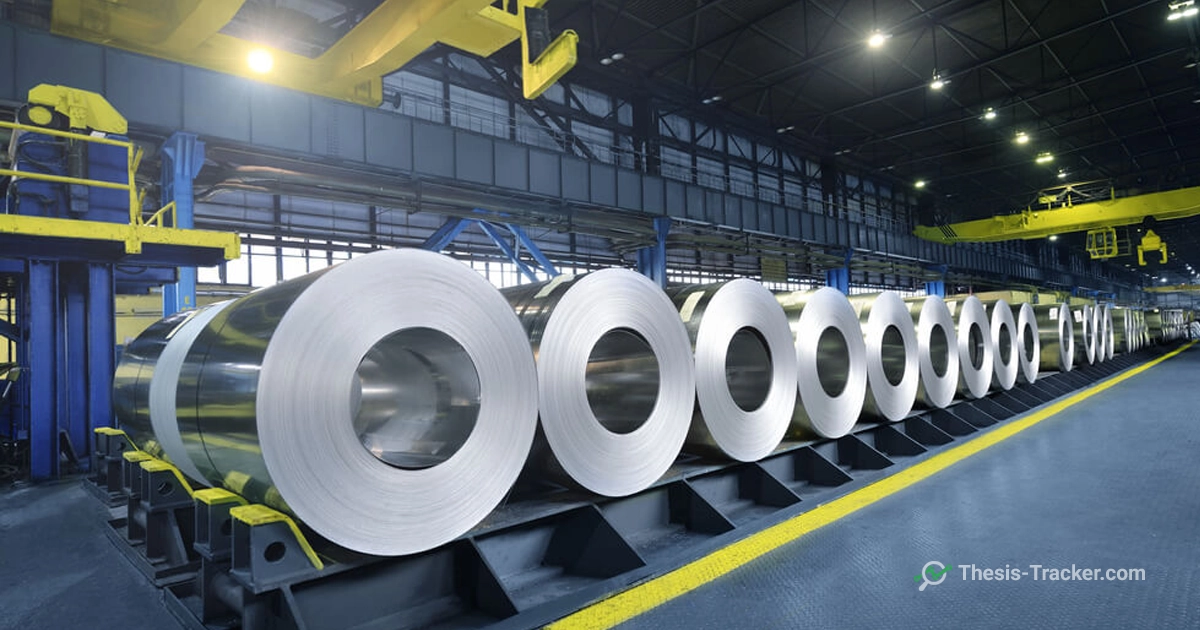
BlueScope beat off a $32.35-a-share bid and grew EBIT 73%. Fund managers are now split on whether US steel spreads can hold.
In Short
BlueScope Steel fended off a $32.35-a-share takeover approach from Seven Group Holdings and Steel Dynamics in 2026 while delivering a 73% jump in underlying EBIT to $1.27 billion.
Fund managers are now split on valuation: Airlie Funds Management rates it a buy on a roughly 10% dividend yield, while WaveStone Capital rates it a sell, arguing US steel spreads are well above mid-cycle levels.
Australia remains the weak link, with EBIT down 28% to $188 million, even as the US North Star mini-mill generates returns on invested capital above 20%.
BlueScope Steel spent much of 2026 fending off a takeover approach while quietly delivering one of its strongest results in years, and fund managers are now debating whether that strength is structural or simply a very favourable point in the US steel cycle. A joint proposal from Seven Group Holdings and US steelmaker Steel Dynamics put a floor under the stock and forced the market to properly value BlueScope's American operations. The FY26 result that followed showed exactly why the suitors were interested, and exactly why some managers now think the good news is close to fully priced in.
A takeover bid that forced the market to look twice
Seven Group Holdings and Steel Dynamics tabled a final proposal of $32.35 per share in cash, or around $34 including already announced dividends, before the process lapsed. First Samuel said it would have been pleased to see the bid succeed, arguing Steel Dynamics was uniquely placed to extract more value from BlueScope's high-quality US assets while Seven Group could have improved the Australian operations. The FY26 result strengthened that case: underlying EBIT rose 73 percent to $1.27 billion and underlying net profit more than doubled to $851 million, with the North Star mini-mill in the US generating a return on invested capital above 20 percent even as steel despatches rose only 3 percent. Australia was the weak link, with EBIT falling 28 percent to $188 million, which First Samuel said reinforced its view that new ownership could have brought sharper capital-allocation discipline. The fund sold around half its position at elevated prices around the bid but still holds BlueScope as a large position.
L1 Capital had been making a version of this argument for some time, noting its long-held view that BlueScope's US operations alone were worth more than the company's entire market capitalisation. When takeover interest in those assets finally emerged, L1 said the broader market began recognising the value it believed had always existed, and counted BlueScope among the US-exposed, value-style stocks that drove a strong period of performance as investors rewarded businesses benefiting from stronger American economic conditions.
US steel strength is doing the heavy lifting
Alphinity Investment Management rated the stock a buy in July, crediting a new chief executive, promoted from chief financial officer and head of the Australian business, for managing the company well through the takeover approach and for making the case for BlueScope's standalone value. Alphinity pointed to US steel spreads up more than 50 percent and improving demand linked to data centre construction, and expected FY27 guidance to be lifted as a result. Blackwattle Investment Partners made a similar point, noting the stock benefited from sustained strength in US hot-rolled coil spreads and strong volumes at North Star, with the valuation floor set by management's rejection of the takeover proposal continuing to underpin the shares. Wilson Asset Management framed the shift more broadly, arguing BlueScope's story has moved from a simple steel price call to a multi-lever one, with the company now past peak capital expenditure and an expected inflection in free cash flow that should support more consistent capital returns.
But the guidance upgrade masked a cost problem at home
Pendal Group's August newsletter offered a more skeptical read of the same result. It noted FY26 came in broadly in line, but the 10 percent upgrade to first-half FY27 guidance disappointed once it became clear it was largely a mark-to-market effect of already known elevated US steel spreads, while earnings elsewhere, particularly in Australia, fell short as cost escalation ate into efficiency gains. On the positive side, Pendal noted the US Coated Products turnaround is progressing and the Asian Coated Products business is gaining share in value-added product, and confirmed the Seven Group and Steel Dynamics bid process has lapsed with no separate sale of the North American business planned. The stock later fell sharply on press reports the United States could cut tariffs on Canadian steel and aluminium from 50 percent to 25 percent, though Pendal said it believes the price impact of that change may be limited.
Bulls and bears now argue about where steel spreads normalise
By September the debate had narrowed to a single question: how sustainable are today's US steel spreads. Airlie Funds Management rated the stock a buy, pointing to a roughly 10 percent dividend yield and potential for a 15 percent total return over 18 months, arguing the non-US business is under-earning even as North America over-earns, backed by a strong balance sheet and capable management, with the prior takeover approach limiting downside.
Believes the non-US business is under-earning even as North America over-earns, backed by a strong balance sheet, capable management, and a prior takeover approach above the current share price limiting downside.— Airlie Funds Management, Article, September 2026
WaveStone Capital took the opposite side, rating the stock a sell on the view that US steel spreads of around $800 a tonne are well above its estimated mid-cycle range of $400 to $500 a tonne, and expecting the share price to come under pressure as margins eventually normalise.
US steel spreads of around $800 a tonne look well above his estimated mid-cycle range of $400 to $500 a tonne, and expects the share price to come under pressure as margins normalise.— WaveStone Capital, Article, September 2026
Investors Mutual Limited took a simpler view, accumulating shares in August at what it called reasonable prices for a sound company. For now, BlueScope's investment case rests on a fork in the road fund managers describe in similar terms but resolve differently: US tariff policy and steel spread normalisation on one side, and an Australian business several believe still has room to close the gap with its American counterpart on the other. Whether management can lift Australia's returns without the pressure of another takeover approach, and how quickly elevated US spreads mean-revert, are the two threads fund managers say will decide which side of that fork the stock ends up on.
Price
Price
Price
Price
Market cap
12 managers
Sector
12 managers
Fund managers
12 managers
First covered
12 managers
Last updated
12 managers
Company Details
ic
Ipsum Capital
6 comments
ic
Amet Funds
4 comments
ic
Dolor
3 comments
Top Investors Covering MIN
Related Themes
Frequently asked questions
Frequently asked questions
Why did BlueScope Steel receive a takeover proposal in 2026?
Seven Group Holdings and US steelmaker Steel Dynamics tabled a proposal of $32.35 per share in cash, or around $34 including dividends, reflecting fund manager L1 Capital's long-held view that BlueScope's US operations alone were worth more than its entire market capitalisation. The process later lapsed.
How strong was BlueScope's FY26 result?
BlueScope's FY26 underlying EBIT rose 73% to $1.27 billion and underlying net profit more than doubled to $851 million, driven by strong US steel spreads and the North Star mini-mill, while Australian EBIT fell 28% to $188 million.
Are fund managers bullish or bearish on BlueScope Steel now?
Views are split. Airlie Funds Management rates the stock a buy on its dividend yield and under-earning non-US business, while WaveStone Capital rates it a sell, arguing current US steel spreads are well above sustainable mid-cycle levels.